Coffee ABC - J is for Jute (Bags)
When we think about coffee, there are a few pictures that come to mind: Holding a tasty beverage in your hands most mornings, a coffee farmer holding a handful of ripe coffee cherries and of course, those colorful printed coffee bags.
Let's dive a bit deeper into the topic of those coffee bags, typically made of jute.
Green coffee (especially Specialty Coffee grade) is usually handled in "small" units of 50-70kg, packed in jute bags. Larger amounts will be handled in bulk bags that hold 1'000kg and smaller amounts, most often very expensive green coffee or very small lots will be handled in 10-30kg bags or vacuum-packed boxes. We will focus mainly on the "standard" Specialty Coffee units.
Historically, the green coffee was packed loosely in a jute bag, allowing for handling, labelling and protection with the upsides of being cost effective and robust. Over time, there have been improvements and tweaks to the bags but in general the system has stuck. Let's dive a bit deeper.
We'll start with the essence, the fiber. Jute is a vegetable fiber produced from the stems of the Corchorus capsularis plant, growing very high (1-4m) and requiring a monsoon climate. It is cultivated throughout Southeast Asia with India and Bangladesh as the primary producers. There are findings that jute has been used for textiles for several thousand years and it is recorded that its production and trade has been a vital economic driver for the region for centuries.
Although it can be used in clothing textile, its rough but durable nature makes it ideal for strings, ropes and sacks meant to hold heavy loads. Which means it is a good way to transport and store green coffee in units larger than 50kg. So going back to the days before hermetic plastics and vacuum packing machines were invented - back to the colonial times of the 18th century - there were several reasons why coffee was handled in jute bags.
Food safety: Green coffee is not problematic when it comes to food safety and hygiene. Especially when you look at the first steps of post-harvest processing, coffee beans will never be handled in a sterile environment. Coffee may be stepped on when being washed and also when dried, which often will take place on a plain concrete patio (i.e. the ground). There is always a bit of dust and debris involved when washing, drying, sorting and bagging green coffee. Which is absolutely OK as dust will be blown off and potentioal germs burnt during roasting. Handling green coffee in jute bags will allow for some dust to enter the bag at the outermost layer but the weave and also the density of a packed bag will keep almost all hazards out.
Durability: As mentioned, the robust nature of jute allows for hieving heavy loads without tearing and spilling goods. The weave also allows for a certain flexibility for taking samples. A sample spear can be inserted and a sample of the bag's content withdrawn without greatly damaging the jute bag. Yes, the weave is temporarily stretched and disrupted but it will sort of settle back into place and usually only a few green beans will be lost.
Flexibility: The sack has a certain flexibility and will adjust to the position it is kept at. For example if it is laid out flat and several bags are stacked, each bag will take on a relatively flat form and allow for a certain height while remaining rather stable (within some limits). If the bag is stood upright, it can be opened and left standing without toppling over. This means it can be loosely closed when in use.
Carrying or schlepping a heavy and full jute bag is also doable thanks to the corners having a certain flexibility allowing for grabbing.
Availability & Price: Jute fabric is widely available and has a very good cost efficiency. However, the downside for most coffee producing countries is that the jute bags must first be imported (usually from Southeast Asia / India) and thus adds time, cost and carbon footprint.
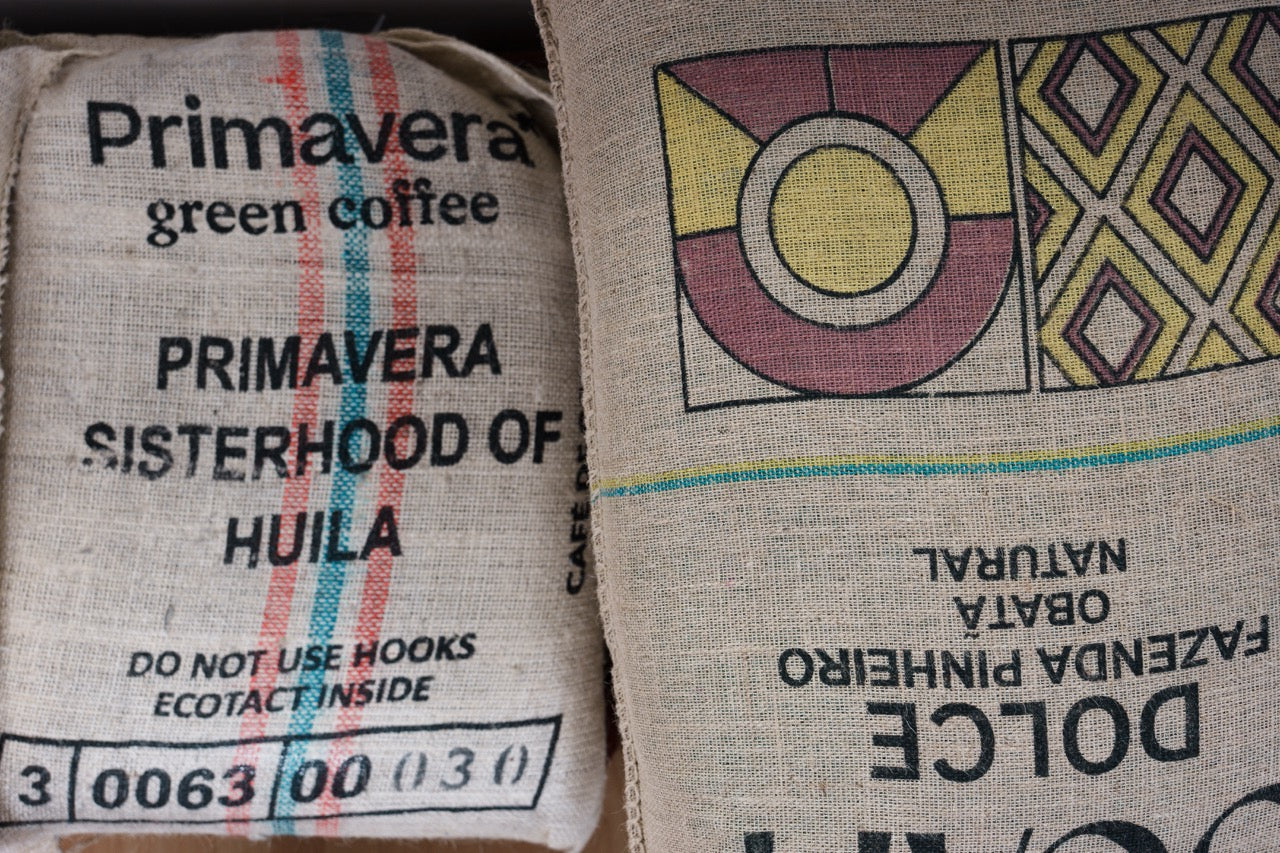
Identification / Customization: Jute bags are easily printable by screen or stencil print. To distinguish different coffee lots along logistics and the value chain, the jute bags must be distinguishable and it's contents traceable and identifiable. This is done easily by marking the bags accordingly. Usually there will be the origin, region, producer and quality and lot number (sometimes including the crop year) mentioned on the bag.
Some origins have a standard thread woven into the bags to make them distinguishable at a glance: Brazil for example will always have a green and yellow stripe across the bag and Colombia will a pink (or red) / green / pink (or red) stripe from top to bottom.
Some coffee roasters securing "their" lots may also add their logo and some producers or handlers will have often beautiful artwork printed onto the bags, making them a collector's item.
Despite all thes pros, over time - and the rise in quality standards mainly in specialty coffee - the demand for a better protection of all the work that has gone into growing and processing the green coffee has brought innovation and improvements to packaging. The most common addition and upgrade to the standard jute bag has been the "Grain Pro". Although "Grain Pro" is just one of many producers, they have become the namesake of plastic liners for the jute bag, keeping odours, humidity, debris and other influences out while preserving mainly the moisture of the coffee beans.
The plastic liners are a simple but very effective way to preserve quality which doesn't require a whole lot of additional equipment or time for the dry mills bagging the green coffee. It does however add (a small) cost to the coffee and that's the reason it isn't always done.
The gold standard in green coffee packaging surely is vacuum packing the beans into 15-17.5kg units and boxing those into 30 or 35kg cartons. The downside is that vacuum packing green coffee requires dry mills to aquire additional equipment and to change their workflow. This probably are reasons why vac-packing hasn't become a standard in the industry but plastic liners have.
Talking about standards... ist there a standard size for a (green) coffee bag? The answer is a big fat NO - it depends on the origin: Brazil will have bags of 59 or 60kg, Africa will have bags of 60kg, Central America 69kg and Colombia 70kg. Then there are half bags which will typically be either 30 or 35kg. The size of Vac Packs will be determined by the lot size (and pricing) but 15 or 17.5kg are common sizes.
Last but not least, we'll cover a question we get asked rather often: What do you do with the used coffee bags? Do you send them back to origin?
The answer is no, they are not sent back to origin. Although the idea of reuse is something we strongly associate with the eco-chic of the jute fabric, this would cause additional carbon footprint and as the print on the bag is unique to each lot, they would need to be reprinted or re-marked which would probably lead to confusion over the contents. The lack of reliability of roasters opening the bags with care and no handlers damaging the bags is probably one of the reasons why folks at origin would rather order their jute bags directly from the producers in Southeast Asia than wait for them to come flying back.
We do however keep the bags for a certain time so we can pass them on to people who would like to use them for gardening, crafting or other purposes. They do stack up and from time to time we do actually just throw them away.
If you have a good idea to repurpose the jute bags, we will be happy to supply you with some. Drop us a line and we'll see how we can get them to you.